Find your hair pattern and make the chart useful
You searched for a hair type chart because you want clear direction. Here’s how to identify your pattern accurately and use it to build a routine that actually suits your hair.
Most “hair type charts” show a tidy grid of patterns from straight to coily. Helpful—until you try to map your real, changeable hair onto a picture. This guide keeps the chart, but adds what it misses: how to observe your hair without product, which extra traits matter, and how to turn a label like “2C” or “4A” into steps you can try today. You’ll finish with a result you can check and refine.
What is a hair type chart—and why use one?
A hair type chart is a shared way to describe curl pattern from straight to coily. The most used version groups hair into Types 1–4 with A–C subtypes for how tight the pattern is; it’s commonly called the Andre Walker Hair Typing System. Treat it as a visual language, not a diagnosis or a ranking.
There are also research-led systems that measure curl geometry rather than just naming it. L’Oréal scientists, for example, have published an eight‑category framework using quantitative features such as curve diameter and a curl index derived from fibre path length, illustrating how pattern can be measured in a lab setting rather than eyeballed from photos (ChemRxiv preprint by Bailey & colleagues).
Which chart should you follow?
- If you want a quick, shared description, use the 1A–4C chart; it’s the language most people recognise when comparing products or techniques.
- If you’re curious about the science or your hair seems to “sit between boxes”, know that measured traits like curve diameter, number of waves per length and path‑length ratio can describe you more precisely.
How to find your pattern at home
Use this once, on clean, product‑free hair:
- Wash and condition as usual, then rinse thoroughly.
- Detangle gently in the shower, then avoid brushing.
- Let hair air‑dry without product. If you must diffuse, use low heat and minimal scrunching so you don’t create a pattern you don’t naturally have.
- When fully dry, match what you see to the families below. This “bare pattern” method mirrors how consumer guides describe the 1A–4C system.
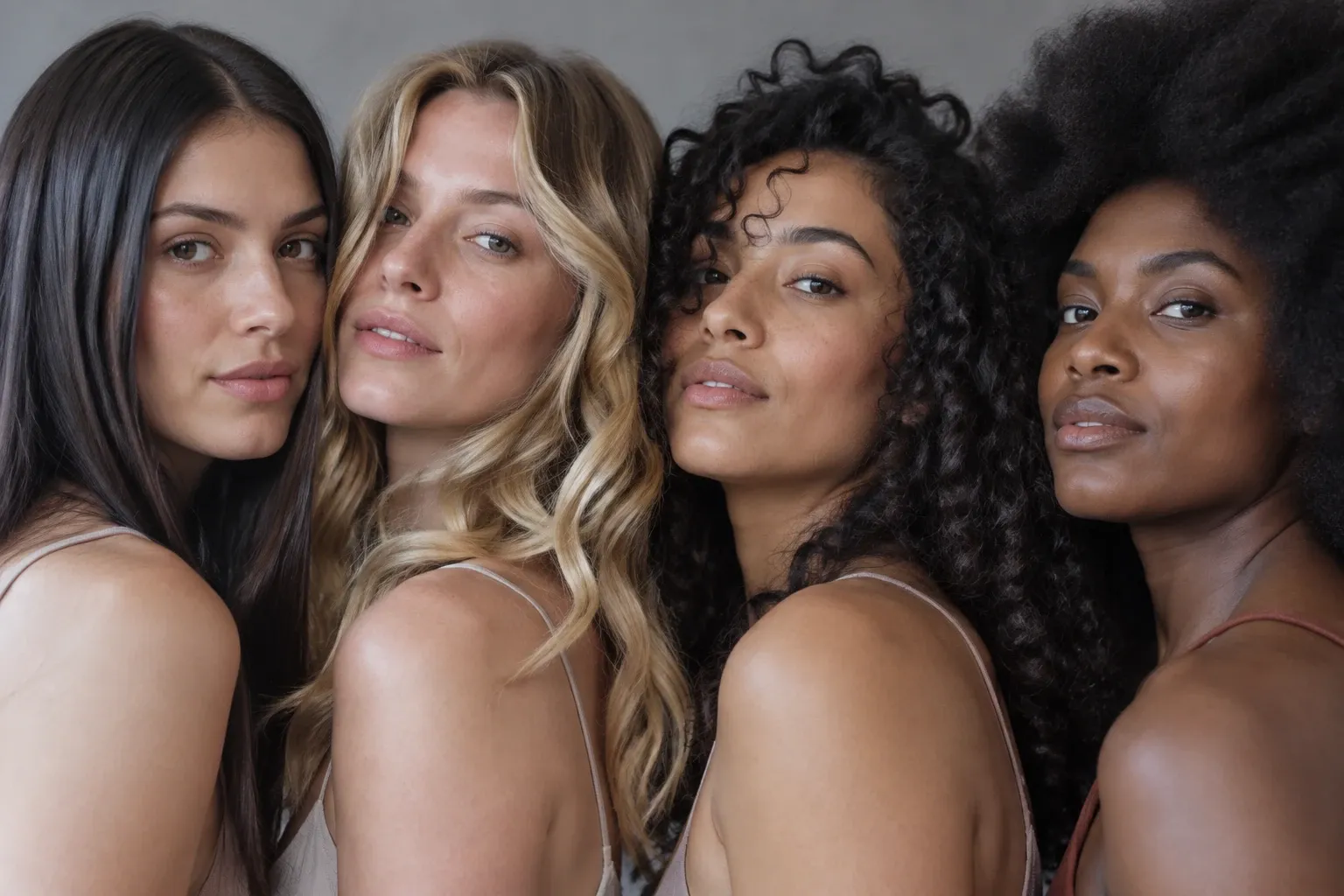
The pattern families at a glance
- Type 1 (straight): strands dry with no visible bend.
- Type 2 (wavy): an “S” wave along the length.
- Type 3 (curly): ringlets or spirals you can trace.
- Type 4 (coily): tight coils or zig‑zag bends with compact volume.
Use the A/B/C letters to note how tight the bend is within your family—A is looser, C is tighter.
What the chart can’t tell you (but your routine needs)
A chart labels pattern; your routine also depends on:
- Porosity: how easily water and ingredients move in and out of the fibre. In research, porosity is quantified by methods such as gas sorption to measure total pore volume and surface area—far more reliable than “float tests” (study on true porosity measurement). If your hair tends to repel water and products sit on top, start with lighter layers; if it soaks up and dries quickly, richer conditioners often help. If this sounds like you, our guide to low porosity hair explains practical signs and product textures to try.
- Strand diameter and density: finer strands and/or lower density usually prefer lighter formulas and gentle hold; thicker strands and/or higher density often need richer conditioners and stronger hold to clump and set.
- Frizz tendency: any pattern can frizz; technique and humidity matter. If halo frizz is your daily battle, see ways to calm it in our piece on frizzy hair.
A simple, usable key
Think of the chart as a key you consult before styling:
- 1A–1C: focus on lightweight volume, root lift, and oil control.
- 2A–2C: enhance waves with light gels or foams; diffuse or plop briefly, then air‑dry.
- 3A–3C: define curl clumps on soaking‑wet hair with gel or custard; diffuse with a bowl and low heat.
- 4A–4C: layer slip for detangling, then rich leave‑in and a defining cream/gel; set in twists, braids or coils if you like structure. These are starting points; adjust based on porosity and strand feel.
Turn your type into a routine
Build a small routine around what you observed: a cleanser, a conditioner, and one styler suited to your family and strand feel. Add or swap one product at a time so you can see what helps. If you want a bigger picture of how to pace wash days, trims and treatments, use our guide to a hair care routine.
How to check you got it right
- Drying time and feel: is the hair touchably soft without residue? If it feels coated, lighten formulas; if it feels rough or parched, add slip and moisture.
- Definition vs. volume: for more definition, apply products wetter and don’t disturb while drying; for more volume, apply a touch lighter and diffuse at the roots.
- Longevity: do results last into day two? If not, adjust hold level and how thoroughly you dry. Revisit your pattern label after a few tries—especially if heat, colour or weather change how your hair behaves. When in doubt, the pattern family steers technique, while porosity and strand feel fine‑tune product weight and leave‑in time (porosity measured scientifically; 1A–4C system for shared language).
Frequently asked questions
Can your hair type change over time?
Your curl pattern is largely set by follicle shape and how the fibre grows, so the broad family (straight, wavy, curly, coily) tends to stay the same. What often changes is appearance and manageability with length, colour services, heat styling, hormones and medication. That’s why it helps to reassess seasonally and after any big change in routine or health.
Is porosity the same thing as hair type?
No. “Type” in popular charts describes pattern; porosity is about how easily water and products move into and out of the fibre. You can have any combination—e.g., coily hair with low or high porosity. Treat them as separate dials: pattern for styling technique, porosity for rinse times, conditioners and protein–moisture balance.
Why do I seem to have two hair types on one head?
It’s common. Hair near the nape or temples may curl differently from the crown; layers, breakage and how sections dry also change the look. In practice, style for the tightest pattern you see, then tweak hold or product amount on looser sections. You don’t need a single label to get consistent results.
Are “float tests” a reliable way to measure porosity?
Not really. Floating a strand in water is influenced by oils, surface tension and product residue. Laboratory methods that quantify pore volume and surface area are used to assess porosity precisely; at home, you’ll get further by observing how long hair stays wet, how quickly it soaks up conditioner and how it responds to richer formulas.
Which matters more: curl type or strand thickness?
Both matter, but for different choices. Curl type mainly guides technique—how you dry, scrunch or set a curl. Strand diameter and density steer how light or rich your products should be, and how much tension or heat your hair tolerates. If results are inconsistent, adjust weight and amount first, then revisit technique.
Related reading